A garage floor can look clean on move-in day and still be poorly suited to real garage life. Hot tires, road salt, dropped tools, oil drips, moisture, and freeze-thaw movement all expose the difference between floor coating versus polishing. Both can improve concrete’s appearance, but they solve different problems. The right choice depends on the condition of your slab, how you use the space, and whether you need protection as much as appearance.
What Polishing Does to a Concrete Floor
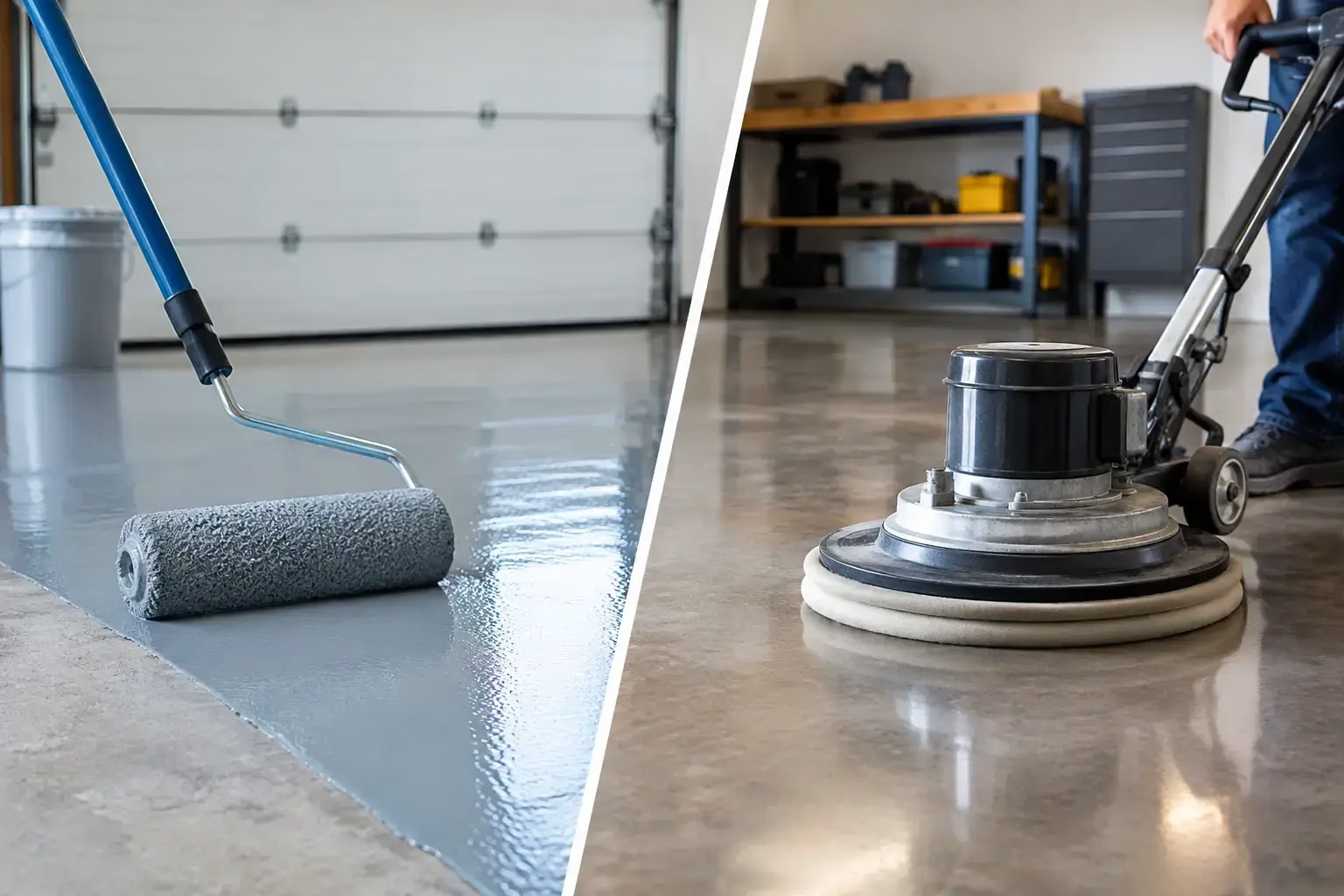
Concrete polishing mechanically grinds the surface, then refines it with progressively finer tooling until it reaches a smooth, light-reflective finish. A densifier may be applied during the process to harden the concrete’s surface and reduce dusting. The finished floor can range from a low-sheen matte look to a highly reflective gloss.
Polishing works best when the concrete is structurally sound, relatively flat, and visually worth exposing. In a showroom, office, retail space, or modern basement with a good-quality slab, it can create an attractive industrial finish without adding a thick surface layer.
That exposed-concrete appearance is also its limitation. Polishing does not conceal major stains, widespread pitting, patchwork repairs, or uneven discoloration. Grinding can reveal aggregate and surface variations, which some owners like and others find distracting. If your garage slab has years of tire marks, de-icing salt damage, oil staining, or old coating failure, polishing may make those imperfections more visible rather than making them disappear.
Polished concrete is easier to clean than bare concrete, but it is not the same as a protective barrier. Liquids can still affect the floor, particularly where the slab has cracks, porous areas, or inconsistent density. A polished finish also requires ongoing cleaning and periodic maintenance to preserve its appearance in high-traffic environments.
Floor Coating Versus Polishing: The Protection Difference
A professionally installed floor coating creates a protective system above the concrete. Rather than asking the existing slab to be the finished surface, coating work starts by preparing and repairing it, then building a durable finish designed for the environment.
For garages, workshops, basements, and commercial spaces, that distinction matters. A high-performance coating can help shield the concrete from automotive fluids, salt, abrasion, moisture exposure, and everyday wear. It also gives you control over the finished look. A full-flake broadcast finish can create a consistent, textured surface that helps camouflage dust and minor debris while delivering a finished, intentional appearance.
At Garage Floors 4 Less, our FloorX2 Fusion+Nano® system is built around professional concrete preparation and multi-layer protection. We repair cracks, pitting, spalling, and damaged areas before installing the system, because a decorative finish is only as dependable as the surface beneath it. The result is not simply a shinier slab. It is a floor designed to make the garage easier to use, clean, and enjoy.
The coating route is especially practical when a homeowner wants to transform a space that currently feels unfinished. A stained concrete floor may be functional, but it rarely feels like part of the home. A properly prepared full-flake floor can change that perception quickly, whether the garage is used for vehicles, storage, hobbies, fitness equipment, or a workshop.
Appearance: Exposed Concrete or a Finished Surface?
The visual decision is usually straightforward. Polishing celebrates concrete for what it is. Its character comes from natural variation, visible aggregate, trowel marks, previous repairs, and the age of the slab. That can look striking in the right setting, but it is not a uniform finish.
A coating gives you more design control. You can select a flake blend that complements cabinetry, slatwall, vehicles, or the rest of the home. The broadcast texture creates visual depth while reducing the plain, grey appearance many people associate with an unfinished garage. It can also make a basement, showroom, or commercial garage look brighter and more cared for.
Neither look is universally better. If your goal is a minimalist, exposed-concrete aesthetic and your slab is in excellent condition, polishing can fit. If you want to hide surface defects, add colour and texture, and create a more complete transformation, coating is usually the stronger choice.
Durability Depends on the Environment
A polished floor can perform well in dry, controlled spaces with regular maintenance. However, garages create a more demanding set of conditions. Vehicles bring in water, salt, gravel, and contaminants. Temperatures shift, especially in Canadian climates where freeze-thaw cycles place additional stress on concrete. The floor must handle more than foot traffic and occasional cleaning.
Conventional epoxy has a long history in garages, but homeowners have also seen its common weaknesses: peeling when preparation is poor, yellowing from UV exposure, and hot-tire pickup. Our FloorX2 Fusion+Nano® nanospartic coating system is engineered for fast curing, UV stability, and resistance to hot-tire pickup, making it a practical option for active residential garages and demanding concrete-slab spaces.
Preparation is the part that cannot be skipped. We mechanically prepare the concrete to create the correct profile for adhesion, address damaged areas, and install each layer as a complete system. Surface cleaning alone cannot replace this work. It is often the reason a floor looks good at first but fails prematurely later.
Repairs and Moisture Should Guide the Decision
Before choosing either option, look closely at the slab. Hairline cracks, flaking, pits, dark stains, soft spots, and previous coating residue all affect what the finished floor can become. Polishing can reduce the visual impact of minor wear, but it cannot make a heavily damaged slab look uniform without extensive corrective work.
Coating is often better suited to repair-driven projects because the process is designed to restore the surface before finishing it. Crack repair and concrete patching do not make structural movement disappear, but they can create a cleaner, more stable foundation for a protective floor system.
Moisture also deserves an honest assessment. Concrete can transmit moisture vapour from below, and garages may experience water intrusion from vehicles, snow, rain, or poor drainage. The answer is not to cover up a moisture issue without diagnosing it. Professional evaluation helps determine whether drainage, concrete repair, moisture mitigation, or a particular coating approach is appropriate for the slab.
Installation Time and Everyday Maintenance
Polishing can be a multi-stage process, particularly when the floor needs significant grinding, stain removal, or repair. It also creates a finish that must be protected from abrasive grit and maintained to preserve its sheen.
A professionally installed coating system can often be completed in one day, depending on site conditions and project scope. That faster turnaround is valuable when the garage is your main entrance, workspace, or storage area. Once complete, a coated floor is typically simple to maintain: sweep away abrasive debris, rinse when needed, and use a mild cleaner for regular washing.
The goal is not a floor that demands special treatment. It is a floor that makes the rest of the space easier to manage. When paired with garage cabinets, overhead storage, or slatwall, a finished coating can help turn an overcrowded garage into a clean, organized extension of the home.
Which Option Is Right for Your Floor?
Choose polishing when you have a high-quality slab, prefer an exposed-concrete look, and are comfortable with natural variation remaining part of the design. It is best viewed as a refinement of the concrete already there.
Choose a professional coating when you want to repair and protect a worn slab, improve traction and visual consistency, resist garage-specific messes, and create a more finished space. Our FloorX2 system is backed by a 15-year all-inclusive transferable guarantee, giving homeowners added confidence that the investment is built for long-term performance.
The most useful next step is to assess the slab honestly instead of choosing a finish from photos alone. Try our Floor Visualizer to explore a full-flake look in your space, or request a free estimate so we can recommend a floor system based on how you actually use your garage.