A commercial concrete floor rarely fails all at once. It starts with tire marks that will not scrub away, dusting at worn traffic lanes, moisture darkening the slab, or small pits that become larger chips. The best commercial floor finishes address those daily realities before they turn into costly repairs, downtime, and an unprofessional-looking space.
For commercial garages, warehouses, showrooms, workshops, and service bays, the right finish is not simply the one with the most shine. It must suit the slab’s condition, the type of traffic, the exposure to chemicals and moisture, and the time available for installation. A finish that looks great on opening day but peels around hot tires or fails at repaired cracks is not a value purchase.
What separates the best commercial floor finishes
A commercial finish should be judged as a complete flooring system, not as a coating selected from a color chart. The visible top layer matters, but surface preparation, crack repair, moisture evaluation, and build thickness determine whether the floor remains bonded to the concrete beneath it.
Concrete has a porous, variable surface. It may contain curing compounds, old coatings, oil contamination, weak laitance, or moisture vapor moving upward through the slab. If these issues are covered rather than corrected, even a premium-looking finish can lose adhesion. Professional diamond grinding creates the surface profile needed for a proper mechanical bond, while repairs restore damaged areas before they are hidden under the finish.
The best choice also depends on how the building operates. A retail showroom may prioritize a polished, consistent appearance and easy cleanup. A vehicle service area needs traction, chemical resistance, and protection against hot-tire pickup. A warehouse needs an abrasion-resistant surface that can handle rolling loads without constant patching. There is no single finish that is ideal for every commercial floor, but there are clear criteria for narrowing the field.
Full-flake nanospartic systems for active workspaces
For many commercial garages, workshops, showrooms, and light industrial spaces, a full-flake broadcast system is one of the most practical commercial floor finishes available. It combines a prepared concrete substrate, a high-performance base coat, decorative flakes broadcast to full coverage, and durable clear coats that seal the system.
The result is a finished floor with visual depth, a consistent appearance, and a texture that helps disguise everyday dust and marks better than a plain solid-color coating. Flake blends can also support a customer-facing environment, turning a service bay or showroom floor into part of the business presentation rather than a worn background surface.
At Garage Floors 4 Less, our FloorX2 Fusion+Nano® system is designed for demanding concrete-slab environments. Its nanospartic technology provides fast cure times, UV stability, and strong resistance to staining and hot-tire pickup. That matters when a business cannot afford to close an area for several days waiting for a floor to cure.
Fast installation does not mean skipping the work that protects the floor. The sequence still begins with professional preparation and concrete repair, followed by the application of compatible layers at the right coverage rate. Many commercial projects can be completed in one day, allowing a faster return to service while giving the floor the protection it needs.
Where full-flake finishes make the most sense
This finish is especially effective in automotive shops, commercial garages, dealership service areas, equipment rooms, retail backrooms, workshops, and customer-facing warehouses. It provides a clean, finished appearance without making the space feel delicate or difficult to maintain.
Texture can be adjusted to the application. A smoother finish is easier to sweep and mop, while a more textured surface can provide additional traction in areas exposed to water, snow, or routine spills. The right balance depends on whether the priority is rolling equipment, foot traffic, vehicle traffic, or all three.
Polished concrete for dry, appearance-driven spaces
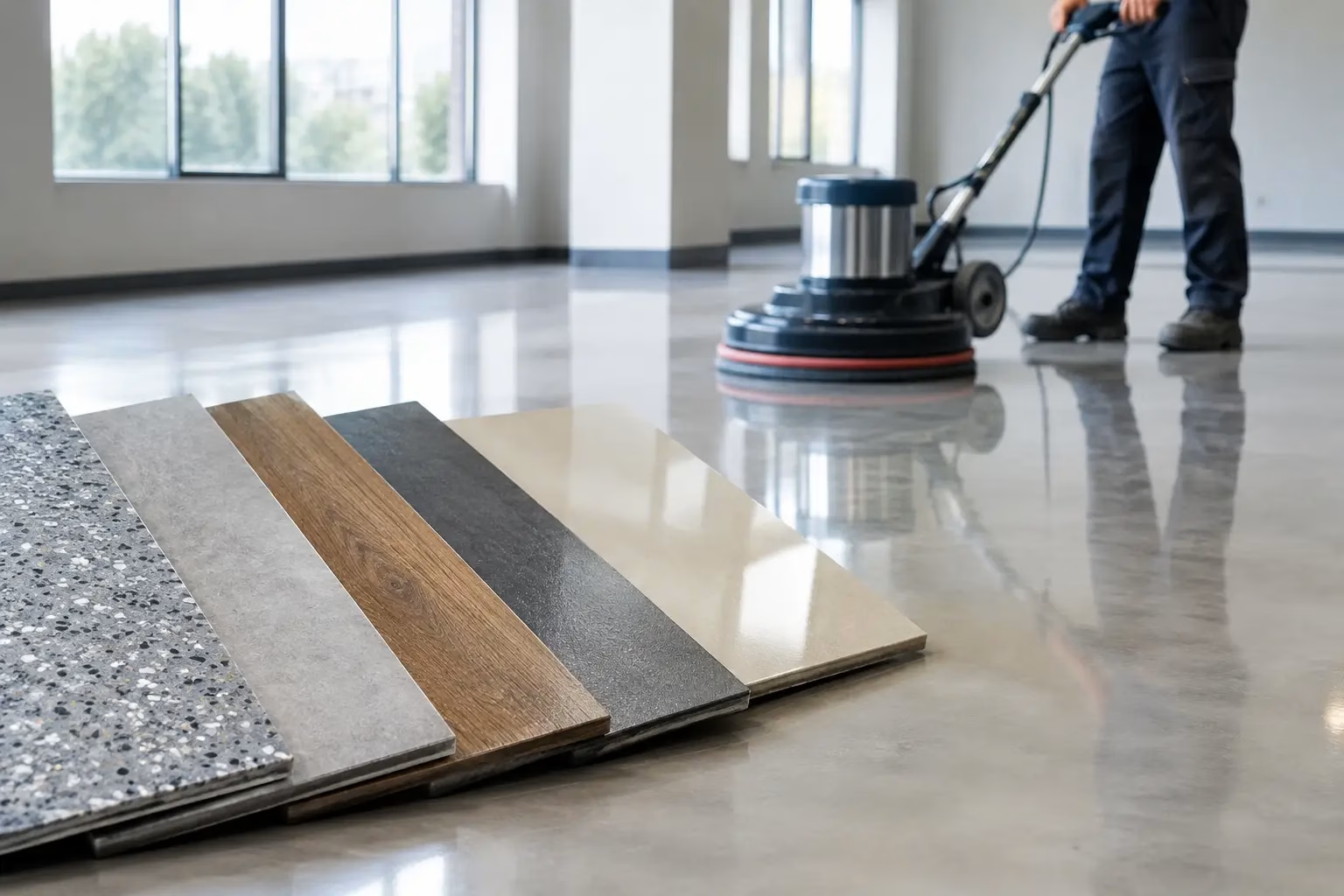
Polished concrete is another strong option when a facility wants to preserve the natural look of concrete while improving light reflectivity and reducing dusting. The surface is mechanically refined through grinding and polishing steps, often with a densifier that hardens the concrete near the surface.
It can work well in retail floors, showrooms, office-adjacent work areas, and dry warehouses where a minimalist appearance is part of the design. Because the concrete itself remains visible, however, existing patchwork, aggregate exposure, and slab color variation may remain part of the final look. That character can be attractive, but it should be expected rather than treated as a surprise.
Polished concrete is not the automatic answer for every commercial environment. It may be less suitable where frequent chemical exposure, persistent moisture, or aggressive impact are major concerns. It also does not conceal a heavily damaged slab in the way a broadcast finish can. If the concrete has widespread pitting, spalling, or old coating failure, repair requirements should be assessed before deciding that polishing is the economical route.
Urethane cement for severe thermal and chemical exposure
Facilities with repeated washdowns, thermal shock, food-processing conditions, or harsh chemical exposure may require a more specialized system, such as urethane cement. These thicker, industrial-grade finishes are selected for performance under conditions that exceed the demands of a typical garage or warehouse.
They can be highly effective, but they are not a casual upgrade. Installation requires careful specification, experienced crews, and a realistic plan for the slab’s moisture and temperature conditions. Their cost and industrial appearance can make them unnecessary for a showroom, vehicle bay, or general-purpose workshop.
This is why the best commercial floor finish is often the one that solves the actual operating problem rather than the one with the most technical-sounding label. Paying for extreme chemical resistance in a low-exposure space may not be sensible. Under-specifying a floor in a wet processing area, on the other hand, creates a much larger expense later.
Why preparation matters more than a product label
Commercial floor failures are often blamed on the topcoat, but the root cause usually starts below it. Oil-soaked concrete, inadequate grinding, unaddressed moisture, and poorly repaired cracks can all compromise a new system. A proper assessment should identify what is happening in the slab before a finish is recommended.
Cracks deserve particular attention. Some are stable and can be repaired before coating. Others reflect movement or expansion joints that need to remain functional rather than being rigidly filled. Spalling and pitting also need more than a cosmetic skim coat. The repair material must be compatible with the selected finish and able to withstand the intended traffic.
This is where a professionally installed system differs from a quick surface refresh. The goal is not to hide the concrete for a season. It is to create a finish that is bonded, repairable, and built around the way the space is used.
How to choose the right finish for your building
Start with the traffic. Ask whether the floor will see passenger vehicles, forklifts, pallet jacks, tool carts, heavy equipment, or concentrated point loads. Next, consider exposure: water, road salt, oil, fuel, cleaners, and seasonal freeze-thaw conditions all influence the right specification.
Then look at appearance and maintenance. A customer-facing floor may need decorative flake coverage and a clean, uniform look. A warehouse might prioritize abrasion resistance and easy sweeping. For an operation that cannot pause for a long installation, cure time becomes a deciding factor as well.
Finally, choose a provider that can evaluate and repair the concrete, not just apply a finish over it. We back our FloorX2 system with a 15-year all-inclusive transferable guarantee because long-term performance should be part of the decision from the beginning, not an afterthought once the floor is installed.
A better commercial floor changes how a space works. It makes cleanup easier, presents a more professional image, and protects the concrete asset beneath daily traffic. To see how a full-flake finish could look in your space, try our Floor Visualizer or request a free estimate from Garage Floors 4 Less.