A garage floor can look dry, feel hard, and still hold enough moisture vapor to compromise a new coating. That is why a proper concrete moisture testing guide matters before choosing colors, flakes, or a finish. Moisture is not always visible, but when it moves through a slab after installation, it can contribute to bubbling, discoloration, loss of adhesion, and premature coating failure.
At Garage Floors 4 Less, moisture testing is part of evaluating the concrete as a complete system. The coating is only as dependable as the surface beneath it. A professional assessment helps us determine whether the slab is ready for preparation and coating, whether repairs are needed first, or whether moisture needs to be addressed before the project moves ahead.
Why garage concrete holds moisture
Concrete is porous. It absorbs and releases moisture through its capillaries, especially when conditions change. In a garage, basement, workshop, or commercial space, that moisture may come from the ground below the slab, high humidity, wet vehicles, snowmelt, drainage issues, or a missing or damaged vapor barrier.
Canadian freeze-thaw conditions make this more relevant for many homeowners. Snow, road salt, and water brought in by vehicles can repeatedly wet the slab surface. Those conditions do not necessarily mean a coating cannot be installed, but they do mean the concrete needs a closer look.
A new slab is also not automatically a dry slab. Concrete continues releasing moisture as it cures, and drying time depends on thickness, indoor conditions, ventilation, temperature, and the materials below it. A calendar date alone is not a reliable moisture measurement.
Concrete moisture testing guide: what we are measuring
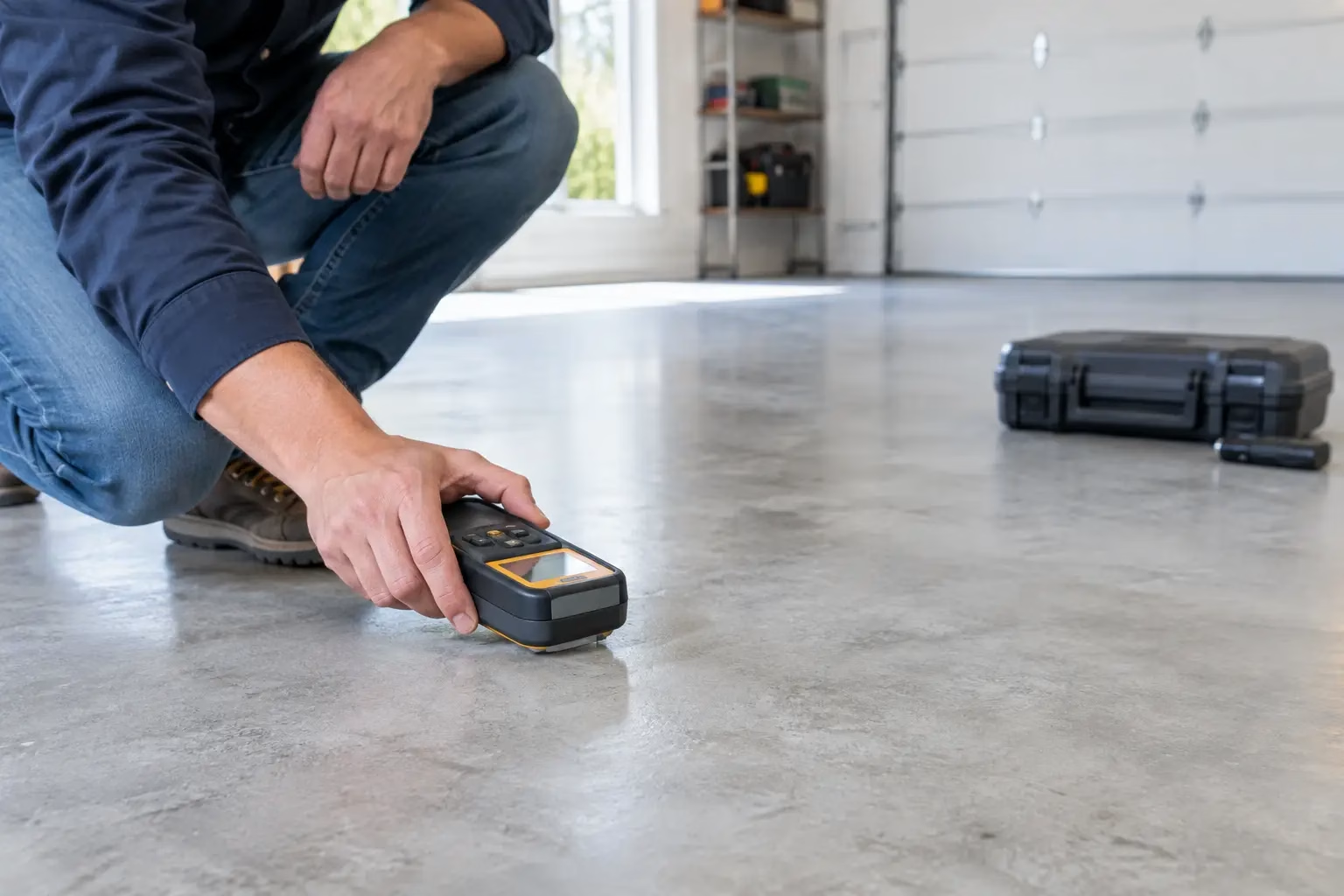
Moisture testing is not simply checking for a wet spot. It evaluates the amount of moisture moving through the concrete or the moisture condition within the slab. That distinction matters because a surface can appear dry after a few warm days while moisture vapor is still moving upward.
Before testing, we inspect the floor for practical signs of trouble. These include dark patches, white powdery deposits known as efflorescence, peeling old coatings, rusted items resting on the slab, recurring dampness near walls, and cracks that may allow water intrusion. We also look outside. Poor grading, downspouts draining beside the garage, and water pooling near the foundation can all affect the slab.
Testing results should never be viewed in isolation. The type of coating system, the slab’s age and condition, site humidity, temperature, and any history of water issues all influence the installation plan.
The plastic sheet test: useful screening, not a final answer
The plastic sheet test is a simple preliminary check. A clear plastic sheet is taped tightly to the concrete and left in place for a period of time. Condensation beneath the sheet or a noticeably darkened section of concrete can indicate moisture activity.
This can be helpful for identifying obvious concerns, but it is not a precise measurement and should not be the only basis for a coating decision. A negative result does not prove that the slab has acceptable moisture levels. It only means the test did not reveal a major issue during that specific period.
In-situ relative humidity testing
In-situ relative humidity testing is one of the most meaningful ways to assess moisture inside a concrete slab. A technician drills to the prescribed depth, places a sensor in the test hole, allows the reading to stabilize, and measures the relative humidity within the concrete.
This approach provides a clearer picture of the moisture condition that a coating may face over time. It is especially valuable for slabs with a history of coating failure, below-grade areas, commercial facilities, or floors that will receive a high-performance system.
The important detail is that acceptable readings depend on the specific coating system and its published installation requirements. There is no universal number that applies to every product. Professional installers match the test method and result to the system being considered rather than relying on assumptions.
Calcium chloride testing
Calcium chloride testing measures the moisture vapor emission rate from the surface of the slab. A prepared test area is covered with a dish of calcium chloride for a set period, then the dish is weighed to calculate the amount of moisture vapor emitted.
This test has been used in flooring for many years and can still provide useful information. However, it measures surface emissions during the test window rather than the internal moisture condition of the slab. On its own, it may not tell the full story, particularly when environmental conditions fluctuate.
For that reason, the best approach depends on the project. A straightforward garage may need a different level of testing than a large warehouse, while a basement with past dampness deserves a more cautious evaluation.
When moisture testing becomes essential
Every concrete floor benefits from a professional inspection, but certain situations call for more formal testing. If the floor has previously peeled, blistered, or developed white mineral deposits, moisture should be treated as a likely contributing factor until testing proves otherwise.
Testing is also strongly recommended when a garage has a history of water entry, a basement feels damp, the slab is newly poured, or the floor is below grade. Commercial garages and workshops deserve the same care because traffic, washing, chemicals, and temperature changes put extra stress on the finished surface.
A crack does not automatically mean moisture is the problem, but cracks can create pathways for water. Before applying a coating, we evaluate cracks, pitting, spalling, and surface deterioration so repairs support the finished system rather than merely hiding damage.
Preparation is the real protection plan
Moisture testing identifies risk. Surface preparation creates the conditions for strong adhesion. Skipping either step is how attractive floors become expensive disappointments.
Mechanical preparation removes weak concrete, old failing material, contaminants, and the smooth surface layer that can interfere with bonding. Proper preparation also opens the concrete profile so the coating system can anchor effectively. A quick acid wash or cosmetic patch is not a substitute for professional substrate preparation.
If moisture readings or site conditions reveal a concern, the solution may involve additional preparation, a compatible moisture-management approach, drainage correction, or delaying installation until conditions are suitable. The right answer depends on the cause of the moisture, not just the symptom.
That is one reason we do not treat garage floor coatings as a one-size-fits-all purchase. A beautiful full-flake floor starts with concrete that has been inspected, repaired, prepared, and tested for the environment it will face.
Choosing a coating system built for real garages
Traditional epoxy has a long history in floor coatings, but garages demand more than a coating that simply looks good on day one. Temperature swings, hot tires, wet vehicles, salt, dropped tools, and constant use require a system designed for demanding conditions.
Our FloorX2 Fusion+Nano® system combines advanced nanospartic technology with a professionally prepared concrete surface. It is designed for UV stability, fast cure times, hot-tire resistance, and the changing conditions common in Canadian garages. The full-flake broadcast finish also creates a clean, finished appearance while helping disguise everyday dust and minor marks.
For homeowners, this means less time worrying about a stained, deteriorating slab and more time using the garage as a functional extension of the home. For commercial properties, it means a floor selected around traffic, maintenance needs, and daily operational demands.
What to do before your coating consultation
You do not need to perform technical testing yourself before requesting a quote. You can make the assessment more productive by noting where water collects, whether the garage has ever flooded, where old coatings have failed, and whether snowmelt or vehicle runoff sits on the floor.
Move vehicles and stored items when possible so the concrete can be inspected closely. If you have photos of past water issues or repair work, keep them available. Those details help identify patterns that may not be visible during a single visit.
The goal is not to find a reason to delay your project. It is to install a floor system that is prepared for your specific slab, so the finished result delivers the durability, easy cleaning, and visual transformation you expect.
Try our Floor Visualizer to explore finishes that fit your garage, then request a free estimate. We will assess your concrete, explain the preparation plan clearly, and help you move forward with a floor backed by our 15-year all-inclusive transferable guarantee.