If you’ve ever had a garage floor coating peel, bubble, or flake within a year or two, the coating probably wasn’t the issue. What’s underneath it usually is.
Every new concrete slab forms a thin, weak layer on top during the pour. It’s called the latent layer, or by its technical name, laitance. Most homeowners have never heard of it. Most coating companies barely deal with it. And that gap is exactly why so many “epoxy” garage floors fail.
Here’s what it is, how it gets there, and why we treat removing it as one of the most important steps in the entire flooring process.
What Is the Latent (Laitance) Layer?
When concrete is poured, it’s a mix of cement, water, sand, and aggregate. As the slab sits and gets finished, the heaviest materials sink and the lightest ones, mainly water, cement fines, and lime, rise to the surface. That rise-to-the-top film is the laitance layer.
It’s soft, chalky, and sometimes has a faint milky look when wet (laitance comes from the French word for milk). It’s not structural concrete. It’s residue that never fully hardened into the strong material underneath it.
How This Layer Actually Forms
Laitance isn’t a defect from bad concrete. It’s a natural by-product of pouring and finishing a slab. It shows up because of things like:
- Bleeding — excess water in the mix rises and carries fine cement particles with it
- Over-troweling — smoothing the surface too much or too long pushes fines upward and seals them at the top
- Fast or uneven curing — if the top dries before it hydrates properly, that top layer stays weak
- Weather during the pour — rain or temperature swings can concentrate more fines at the surfaceAlmost every concrete garage floor has some version of this layer. The question isn’t whether it’s there. It’s what happens when someone coats over it.
Why It Matters More Than People Think
A coating is only as strong as what it’s bonded to. If you apply epoxy, polyaspartic, or any coating directly onto the laitance layer, you’re not bonding to concrete. You’re bonding to a thin film of weak residue sitting on top of concrete.
That residue also holds onto oil, grease, and other contaminants that soak into a garage slab over the years. So you end up with a coating stuck to a layer that’s already weak and already contaminated. Add vehicle traffic, temperature swings, ongoing Moisture Vapor Transmission (MVT), and time, and that’s how you get peeling, bubbling, and delamination, even from coatings that were installed correctly on the surface.
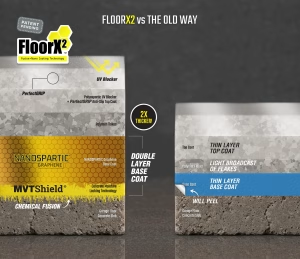
A weak top layer like laitance, combined with intense moisture vapor transmission year-round, creates a very weak and unstable base to apply epoxy, polyurea, or polyaspartic onto. Those coatings only sit on top of that base. FloorX2’s first layer, MVTShield, is built differently. It penetrates deeply into the concrete and bonds below the surface instead of resting on top of it.
The Industry Shortcut: CSP 1–2
In the concrete industry, surface prep is measured using something called a Concrete Surface Profile, or CSP, on a scale of 1 to 9. It describes how aggressive the surface preparation actually is.
Many coating companies grind or acid-etch just enough to hit a CSP 1 or 2. That’s enough to knock down gloss and open the very top of the slab, and it’s fast and inexpensive. But a light CSP 1–2 profile often only scuffs the laitance layer instead of removing it. The coating goes on, looks great on day one, and is still bonded to that same weak film underneath.
We Test for It Before We Ever Grind
Not every slab has the same amount of laitance. A driveway poured in July behaves differently than one poured in October. A slab that was heavily troweled has a different profile than one that wasn’t. That’s why testing the laitance layer is part of our flooring assessment, not something we guess at once we’re already on site.
Before a single tool touches your floor, our crew evaluates the condition of the slab so they show up with the right grinding equipment for what your specific garage actually needs. It’s a small step most homeowners never see, but it’s the difference between a coating that’s cosmetic and one that’s actually bonded into the concrete.
The GF4L Standard: CSP 3–4, One-Sixteenth of an Inch Deep
We don’t scratch the laitance layer. We scarify it off.
Our process mechanically removes the top of the slab to a CSP 3–4 profile, roughly one-sixteenth of an inch deep. That’s enough to get past the laitance entirely and expose the solid, porous concrete underneath, the material that’s actually strong enough to bond to.
This matters specifically because of how our MVTShield system works. MVTShield is designed to penetrate into open concrete pores and fuse below the surface, not sit on top of it like a paint film. That kind of penetration only works if the pores are actually open and the surface is clean of weak residue. Removing the laitance layer first is what makes that bond possible in the first place.
After We Grind, We Test Again: The Density Test
Removing the laitance layer isn’t the last step before coating. Once our technician finishes grinding and scarifying the slab to CSP 3–4, they run another test on the exposed concrete called the Density Test.
This test tells us exactly how dense and porous that specific slab is now that the weak layer is gone. We use those results to adapt MVTShield with ACT to that floor. MVTShield isn’t a one-size-fits-all product straight out of a bucket. It’s custom formulated to the concrete in front of us, based on what that slab actually needs to bond and
The Bottom Line
A garage floor coating is only as good as what’s underneath it. Grinding a little and calling it prep might look fine on install day. Removing the laitance layer and exposing real, open-pore concrete is what makes a coating last.
That’s the difference between scratching a surface and preparing one.
Curious what’s really going on under your garage floor? Book a flooring assessment and we’ll show you exactly what we find.