Consumer Education Blog | Garage Floors 4 Less
Why garage floor coatings peel?
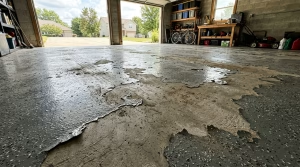
You’ve probably seen it — a garage floor that looked great for a year or two, then started bubbling, cracking, and peeling in sheets. It’s one of the most common questions we hear: “How do I know this won’t happen to mine?”
The honest answer is that most coating failures aren’t random. They’re predictable — and preventable, if the right system is used from the start.
Why Do Garage Floor Coatings Peel?
Coating failure almost always comes down to one thing: the coating lost its grip on the concrete underneath. But the reason it loses that grip is usually happening beneath the surface — long before any visible damage shows up.
The four most common causes are moisture, poor surface preparation, weak adhesion, and low-quality coating systems. Understanding each one helps you ask the right questions before you commit to a contractor.
Moisture Beneath the Concrete
Concrete is far more porous than most people realize. Even when a garage floor looks completely dry, moisture can still be moving through it from below — a process called moisture vapour transmission (MVT).
When that moisture gets trapped beneath a coating, it builds pressure. Over time, that pressure causes bubbling, blistering, lifting, and eventually peeling — especially in climates that deal with snow, slush, road salt, and seasonal temperature swings.
Most contractors never test for moisture vapour transmission. They assume if the floor looks dry, it is dry. That assumption is one of the leading causes of premature coating failure.
If your contractor doesn’t address MVT as part of their process, you’re accepting a risk that most homeowners don’t even know exists.
Poor Surface Preparation
A coating can only bond as well as the surface beneath it allows. Some installers skip proper preparation — relying on acid washing or basic cleaning instead of mechanical grinding. The result is a floor that looks fine at first but has nothing solid to hold onto.
Professional preparation means mechanically profiling the concrete surface so the coating can grip it properly. It also means repairing cracks and pits before any product goes down. Shortcuts here are the single biggest predictor of early failure — regardless of how premium the coating is.
Weak Adhesion
Adhesion is how well the coating bonds to the concrete. Dust, oil, moisture, old coatings, and inadequate surface profiling all weaken it. A floor with poor adhesion might look perfectly fine for the first season, but hot tires, road salt, and daily traffic will expose the weakness quickly.
Strong adhesion isn’t an accident. It’s the result of proper inspection, preparation, and the right base coat applied to a correctly prepared surface.
Low-Quality or Thin Coating Systems
Not all coating systems are built the same. Some low-cost options are thin single-layer products that sit on top of the concrete rather than bonding to it. They may look sharp at installation, but they weren’t engineered for real garage conditions — vehicle traffic, hot tires, dropped tools, chemical spills, and ongoing moisture exposure.
A system built to last is multi-layered, with each layer doing a specific job. Homeowners should be asking what system is being installed — not just what colour or finish they’re getting.
How Garage Floors 4 Less Approaches This Differently
At Garage Floors 4 Less, we don’t treat a garage floor as a surface coating job. We treat it as an engineered system — because that’s what it takes to make it last.
Our process is built around the reasons coatings fail, not just the look of the finished product.
MVTShield: Addressing Moisture Before It Becomes a Problem
MVTShield is our moisture vapour transmission management layer — applied before the rest of the system goes down. It addresses the moisture moving through the concrete from below, which is the hidden failure point most contractors ignore entirely.
For homeowners, this means protection where it matters most: beneath the floor system, where problems start.
NanoSpartic: A Base Coat Built for Real Garage Conditions
NanoSpartic is our premium base coat. It’s designed for strength, adhesion, impact resistance, and chemical resistance — because the base coat is where most systems cut corners, and where the entire floor system either holds together or doesn’t.
This is the layer that bonds the coating to the concrete. Getting it right matters more than the colour you pick.
TiSpartic: A Topcoat That Actually Protects
TiSpartic is the protective wear layer — the surface you see and drive on every day. It’s engineered for durability, UV resistance, chemical resistance, and daily garage traffic. It can also include a slip-resistant additive for safety when the floor is wet.
The topcoat is what protects everything beneath it. It needs to be tough enough to handle what a real garage throws at it.
A System That Works Because Every Layer Has a Job
Our full process may include:
- Concrete inspection and moisture assessment
- Mechanical surface profiling
- Crack and pit repairs
- MVTShield moisture protection layer
- NanoSpartic base coat
- Decorative flake broadcast
- TiSpartic protective topcoat
- Front lip waterproofing where needed
Each layer earns its place. Together, they create a floor system designed to resist peeling, lifting, and fading over the long term.
Questions to Ask Before You Hire Anyone
The best way to protect yourself is to ask the right questions before work begins:
- Do you mechanically profile the concrete, or rely on acid washing?
- Do you repair cracks and surface damage before coating?
- Do you test for moisture vapour transmission — or assume the floor is dry?
- What base coat and topcoat system do you use, and why?
- Is your system designed for Canadian weather conditions?
- What warranty or guarantee is included?
- Are your crews licensed, trained, and insured?
A contractor who can answer every one of those questions clearly and confidently is a contractor worth hiring.
The Bottom Line
Peeling isn’t inevitable. It’s the predictable result of skipped steps, missed moisture, and systems that weren’t built for the job.
A garage floor should be the last thing you have to think about. That’s what a properly engineered system delivers — and it’s the only kind we install.
If you’re considering a garage floor coating, we’d be glad to walk you through our process, assess your concrete, and recommend the right system for your space. Contact us today for a free estimate.