Consumer Education Blog | Garage Floors 4 Less
Why Garage Floor Coatings Peel and How to Prevent It?
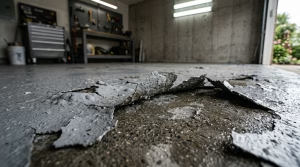
When a garage floor coating fails, most people blame the product. The coating must have been cheap. The epoxy must have been low quality. The colour must have faded for a reason.
But in most cases, the product isn’t what failed. The process did.
Understanding the difference is what separates a garage floor that lasts a decade from one that starts peeling in two years — and it changes how you should be evaluating every contractor you talk to.
Surface Coatings vs. Engineered Systems
Most garage floor coatings on the market are exactly what they sound like: coatings. They’re applied on top of the concrete, they look great initially, and they’re priced to win the job. What they’re not is engineered for the concrete beneath them.
Concrete is porous, reactive, and constantly dealing with moisture from below. A product that simply sits on top of it — no matter how premium — is fighting a losing battle against a slab that was never properly prepared to receive it.
An engineered system works differently. It starts with understanding the condition of the slab, addresses what’s happening beneath the surface, and builds upward in layers — each one doing a specific job.
Moisture: The Problem Nobody Talks About
Moisture vapour transmission (MVT) is the movement of moisture through concrete from below. It’s invisible, it’s constant, and in Canadian climates with seasonal freeze-thaw cycles, it’s significant.
When moisture gets trapped beneath a coating, it builds pressure. That pressure eventually wins — the coating bubbles, lifts, and peels. This can happen six months after installation or six years later, depending on how much moisture is moving and how well (or poorly) the system was designed to handle it.
Most contractors never test for MVT. They coat the floor, collect the cheque, and leave the homeowner to deal with the consequences.
Testing for moisture vapour transmission before installation — and building a system that addresses it — is one of the most important things a contractor can do. It’s also one of the least common.
Preparation Is Not Optional
The most expensive coating in the world will fail if the concrete beneath it wasn’t properly prepared. This is where most coating failures actually start.
Proper preparation means mechanically grinding the surface to create the right profile for bonding. It means testing for moisture. It means repairing cracks, pits, and surface damage before any product goes down. And it means inspecting the slab for anything that could compromise adhesion.
What it doesn’t mean is acid washing and calling it done.
Acid washing was the industry standard for decades, and many contractors still rely on it because it’s faster and cheaper than mechanical grinding. The problem is that it often doesn’t open the concrete surface enough for a reliable bond — and on slabs with contamination or sealers, it does almost nothing.
Why the Base Coat Matters More Than the Topcoat
Homeowners spend most of their energy choosing a finish colour or topcoat brand. That’s understandable — it’s the part of the floor you can actually see. But the base coat is where the system either holds together or doesn’t.
The base coat is what bonds the system to the concrete. If that bond is weak — because of poor surface prep, the wrong product, or inadequate application — the rest of the system is sitting on a foundation that will eventually let go.
A premium base coat, applied to a properly prepared surface, is what makes the topcoat worth investing in. Without it, you’re paying for aesthetics on top of a liability.
The Layered System Approach
At Garage Floors 4 Less, we build every floor as a system — not a single coating event. Our process is engineered around the specific failure points that cause most coatings to fail.
MVTShield — Moisture Management
Applied before anything else, MVTShield addresses moisture vapour transmission directly. It creates a barrier that manages the moisture moving through the concrete, so the rest of the system isn’t fighting an invisible force from below.
NanoSpartic — Strength and Adhesion
NanoSpartic is our base coat. It’s engineered for adhesion, impact resistance, and chemical resistance — because a base coat that can’t stand up to real garage conditions isn’t protecting anything.
TiSpartic — Surface Protection
TiSpartic is the topcoat that handles everything the floor faces daily: vehicle traffic, hot tires, UV exposure, road salt, moisture, and chemical spills. It’s also available with a slip-resistant additive for wet conditions.
Together, these layers create a floor system that’s designed to hold — not just look good on installation day.
What to Look for in a Contractor
The quality of your garage floor comes down to the quality of the process. Before you sign anything, ask these questions:
- Do you mechanically grind the surface, or use acid washing?
- Do you test for moisture vapour transmission?
- What happens if you find significant moisture or slab damage?
- What’s in your base coat — and why did you choose it?
- How many layers does your system include, and what does each one do?
- Is your system designed for Canadian climate conditions?
- What does your warranty cover, and for how long?
If a contractor can’t answer these clearly, or if the answer to most of them is “we use a standard epoxy system,” that’s useful information.
The Standard We Hold Ourselves To
We don’t compete on price. We compete on process — because a garage floor isn’t a product you buy once and replace. It’s something you live with every day, and the difference between a floor that holds and one that peels is almost entirely in how it was installed.
Our crews are trained, licensed, and insured. Our system is built around the Canadian climate. And our process starts with understanding the condition of your specific slab — not assuming it’s ready.
Most companies coat your floor. We engineer a permanent bond inside it. That’s not a marketing line — it’s the difference in what we actually do.
If you want to understand what your floor actually needs — and what it would take to do it right — contact us. We’ll assess your concrete, walk you through our process, and give you a straight answer.